Table of Contents
- How Long Does It Take to Dry Out After Water Damage? The Short Answer
- How to Dry Out a House After Water Damage: A First-Hours Action Plan
- Surface Drying vs. Structural Drying: Why the Difference Matters
- How Long Does Drywall Take to Dry After Water Damage?
- Can Water Damage Dry on Its Own?
- Water Damage Restoration Drying Equipment: What Actually Gets Used
- How to Tell When Drying Is Actually Complete
- Frequently Asked Questions
Last Updated: October 21, 2026
How Long Does It Take to Dry Out After Water Damage? The Short Answer
Most homes dry out in 3 to 7 days after water damage, assuming the water is extracted quickly and professional drying equipment runs continuously. That range comes from the IICRC S500 standard, the industry’s benchmark for water-damage restoration.
The exact answer to how long does it take to dry out after water damage depends on three things: how much water came in, what materials got wet, and how fast drying starts. A flooded basement with soaked drywall and subfloor can run 3 to 7 days or more.
The 3 to 7 Day Rule for Most Homes
Three to seven days is the working target for a typical home. It is not a guarantee.
- Category 1 water (clean supply-line leak): often dry in 2 to 3 days
- Category 2 water (washing machine, dishwasher): 3 to 5 days
- Category 3 water (sewage, ground flooding): 3 to 7 days, and some materials must be removed
Mold can begin growing on wet building materials within 24 to 48 hours, according to EPA guidance on mold and moisture. That single fact drives every decision below.
How to Dry Out a House After Water Damage: A First-Hours Action Plan
The first few hours decide whether drying takes 3 days or 3 weeks. Move fast, and document everything.
Step 1: Identify the Water Category Before You Start
Restoration practice groups water damage into three categories, and the category drives every decision that follows:
- Category 1 (clean water): supply-line leaks, broken ice-maker lines, rainwater that has not touched soil or waste. Safe to handle with basic precautions, and most materials can be dried in place.
- Category 2 (gray water): washing machine discharge, dishwasher overflow, toilet bowl water without solid waste, and clean water that has sat for more than about 48 hours. Contains contaminants that irritate skin and lungs. Wear gloves and eye protection, and expect some porous materials to be unsalvageable.
- Category 3 (black water): sewage backups, ground-surface flooding, and water from toilets beyond the trap. Assume pathogens are present. Do not handle it without professional-grade protective equipment, and plan on removing porous materials such as carpet, pad, and drywall rather than drying them.
A common pattern is for homeowners to treat a Category 2 or 3 loss like a clean leak, dry the materials in place, and then wonder why odors and mold return. When in doubt, treat the water as the more contaminated category.
Step 2: Stop the Water and Make It Safe
- Shut off the water source or the main valve.
- Cut power to wet rooms at the breaker. Never stand in standing water near live outlets.
- Photograph every affected room before you move anything. Your insurance claim depends on it.
- Call your insurer and open a claim the same day.
- Keep people and pets out of rooms with Category 2 or 3 water until the area is cleaned and disinfected.
Step 3: Extract Standing Water and Start Airflow
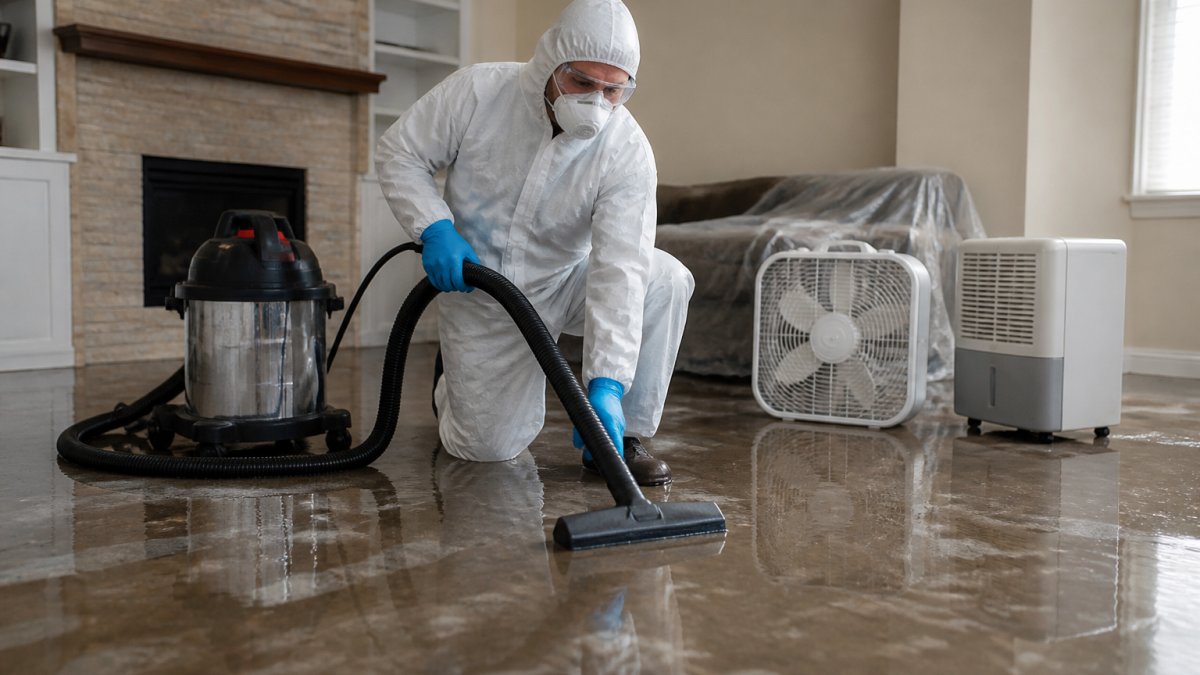
- Remove standing water with a wet/dry vacuum or pump. On Category 3 water, use equipment you can disinfect or discard afterward.
- Pull up soaked rugs and move furniture off wet carpet. Bag and discard carpet pad exposed to Category 2 or 3 water.
- Open windows only when outdoor humidity is low. Otherwise, seal the room and rely on dehumidifiers.
- Set up fans and a dehumidifier, and run them nonstop.
- Check hidden spots: under baseboards, inside wall cavities, beneath cabinets.
That last step matters more than most people realize. Water hides in cavities and under flooring, and surface drying alone will not reach it. If the water was contaminated, surface drying is not enough on its own, the affected surfaces also need to be cleaned and disinfected before drying is complete.
Category 3 water is not a DIY job. Sewage and ground flooding carry bacteria and other pathogens that ordinary fans and shop vacuums spread rather than remove. Call a professional before you start extraction.
Step 4: Document as You Go
Photograph and video each room before, during, and after extraction. Keep receipts for any equipment you rent or buy, and note the date and time you first noticed the water. Adjusters use that record to separate covered damage from pre-existing conditions, and it supports the case for any materials that had to be removed because of contamination.
Surface Drying vs. Structural Drying: Why the Difference Matters
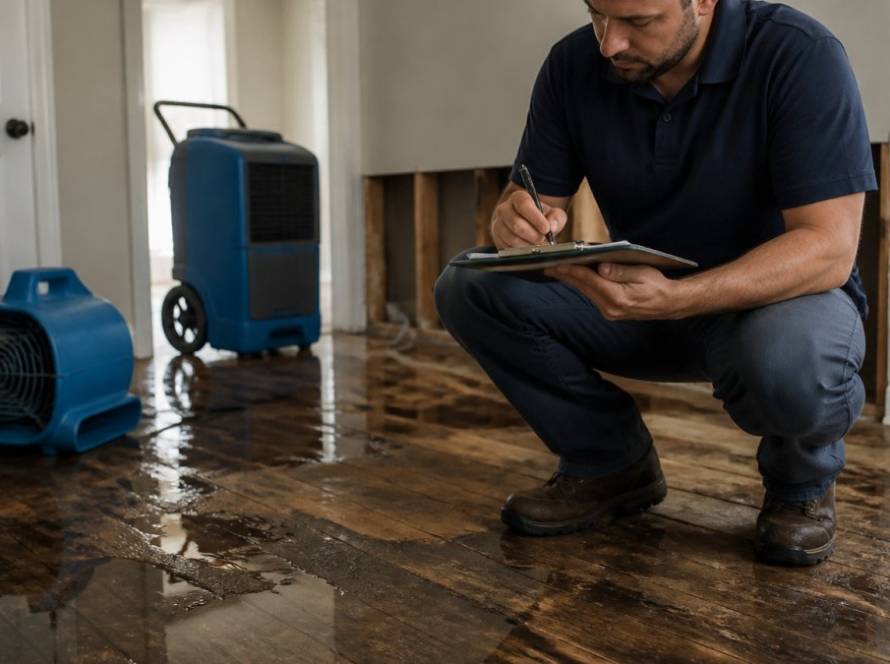
Surface drying means the top layer of carpet or drywall feels dry to the touch. Structural drying means the framing, subfloor, and insulation behind it are dry too.
Here is the trap. A room can feel dry in a day while the studs behind the drywall stay wet for a week. That hidden moisture feeds mold and warps wood.
Stopping when surfaces feel dry is the most common DIY mistake we see. The material looks fine, but trapped moisture in cavities and subfloors causes mold to return months later.
Structural drying requires airflow into cavities, controlled humidity, and moisture readings, not just a fan pointed at the floor. That is why the two are treated as separate milestones on every job.
How Long Does Drywall Take to Dry After Water Damage?
Drywall typically dries in 3 to 5 days if the water was clean and reached it briefly. Soaked drywall that has been wet for more than 48 hours usually needs to be cut out and replaced.
The paper facing on drywall holds moisture and supports mold growth. If the drywall is sagging, crumbling, or showing dark spots, removal is the safer call.
Carpet, Subfloor, and Wood: Material-by-Material Timelines
| Material | Typical Drying Time | Notes |
|---|---|---|
| Carpet and pad | 24 to 72 hours | Replace pad if soaked with dirty water |
| Drywall | 3 to 5 days | Cut out if wet beyond 48 hours |
| Wood flooring | 3 to 7 days | May cup or warp; sanding may be needed |
| Subfloor | 3 to 7 days | Often hidden; needs moisture readings |
| Wood framing | 3 to 7 days | Structural drying with cavity airflow |
| Insulation | Replace, do not dry | Wet insulation loses value and traps moisture |
| Concrete | 1 to 3 days surface | Slab moisture can linger for weeks |
These ranges assume extraction and equipment run from day one. Add days if drying starts late.
Can Water Damage Dry on Its Own?
Sometimes, but rarely well. A small spill on a hard surface can air-dry in a day or two with open windows and a fan.
Anything more than that usually will not dry on its own. Water wicks into materials and spreads. Humidity trapped in a closed room slows evaporation. And mold can start within 24 to 48 hours, well before most people notice a problem.
If the wet area is bigger than roughly one square meter (about the size of a large bath mat), or the water came from a leak inside a wall, call a professional. Small spills dry fine on their own. Wall cavities and subfloors do not.
Water Damage Restoration Drying Equipment: What Actually Gets Used
Professional drying relies on a small set of tools working together. Each one solves a different problem.
- Extraction units: wet/dry vacuums and pumps that pull standing water out fast
- Air movers: high-velocity fans that push air across wet surfaces and into cavities
- Dehumidifiers: remove moisture from the air so wet materials keep releasing water
The key is balance. Fans without dehumidifiers just move damp air around. Dehumidifiers without airflow cannot reach trapped moisture. An IICRC-certified team sizes the equipment to the job and monitors it daily.
How to Tell When Drying Is Actually Complete
Drying is complete when moisture readings return to normal, not when surfaces feel dry. That is the only reliable test. The problem is that most people have no idea what a normal reading looks like, so they stop when the carpet feels dry and the wall looks fine, and the framing behind it stays wet for another week.
What Moisture Meters Actually Measure
Two types of meters do most of the work:
- Pin-type meters drive two electrodes into a material and measure electrical resistance between them. Water conducts electricity, so wetter material reads higher. These give a numeric reading for wood framing, subfloor, and drywall, and they are the standard for documenting drying progress.
- Pinless (capacitance) meters scan through a surface without penetrating it. They are fast for finding where moisture is concentrated behind tile, under vinyl, or inside a wall, but they give relative readings rather than a precise moisture content.
Thermal cameras add a third layer. They do not measure moisture directly; they show temperature differences, and evaporating water cools surfaces. A cold patch on a wall is a strong hint that moisture is present, and it tells you where to put the pin meter next.
Establishing a Dry Baseline
A reading means nothing without a comparison point. Before drying begins, take readings in an unaffected area of the same material, a dry section of the same wood subfloor, a dry stud in the same wall, a dry patch of the same drywall.
For wood framing and subfloor, practitioners commonly target a moisture content in the range of roughly 10 to 15 percent, depending on the species and the local equilibrium moisture content.
The Three Completion Checks
Three checks are used together, and all three have to pass:
- Moisture meter readings in every affected material match the dry baseline taken from unaffected material of the same type.
- Relative humidity in the space stays in a normal range for the season, typically in the 30 to 50 percent band, and does not climb when the dehumidifier is turned off.
- No hidden moisture shows up in thermal scans of walls and floors, and pin readings taken in cavities and under flooring match the baseline.
A room that passes the touch test but fails any of these three is not dry. Keep the equipment running.
Judge drying by readings, not by touch. A room that feels dry can still hide wet framing. Objective moisture checks are what prevent mold from coming back.
Documenting Completion for an Insurance Claim
If you are handling a claim, keep daily moisture logs. Record the date, the room, the material, the meter type, and the reading, and photograph the meter display next to the material being tested.
If you are doing the work yourself, rent or buy a pin-type meter and take readings in the same spots each day. The pattern matters more than any single number: readings that keep dropping mean drying is working, and readings that stall mean air is not reaching the wet material.
Frequently Asked Questions
Can drywall be saved after water damage?
Sometimes. Drywall that soaked up clean water and was caught within 24 to 48 hours can often be dried in place using air movers and dehumidifiers, especially if the damage stays above the baseboard line. Once drywall is saturated, sagging, crumbly, or exposed to contaminated water, removal and replacement is the safer route. Because drywall is porous and holds moisture inside the paper facing, a moisture meter reading is the only reliable way to confirm it dried fully. If readings stay high after a few days of drying, the affected section usually needs to come out.
How fast does mold start after water damage?
Mold can begin colonizing wet materials in as little as 24 to 48 hours when humidity and moisture levels stay elevated. That window is why drying time matters so much: the faster standing water is extracted and airflow begins, the less chance mold has to establish. Porous items like carpet padding, insulation, and drywall paper are the first to support growth. If a property has been wet for more than two days without drying equipment running, treat mold as a real possibility and have the space inspected before assuming it dried out on its own.
Can water damage dry on its own?
Small spills on hard, non-porous surfaces can air dry without help. Real water intrusion rarely does. Water that soaked into drywall, subfloor, insulation, or carpet padding stays trapped where household airflow cannot reach it, and relative humidity inside the wall cavity stays high enough to support mold growth. Hidden moisture in cavities and under flooring is the most common reason a home looks dry but is not. Without extraction, air movers, and dehumidifiers, trapped water can linger for weeks and cause structural damage and odor.
How can you tell when water-damaged materials are completely dry?
Visual inspection is not enough. Restoration technicians use moisture meters and thermal imaging to read moisture levels inside drywall, wood, and subfloor, then compare those readings against a dry reference point in the same home. Drying is complete when structural materials return to normal moisture content and relative humidity in the affected area holds steady. Ask for the meter readings before equipment is removed. If a contractor cannot show you documented moisture readings, you have no way to confirm the structure is actually dry rather than just dry to the touch.
Water damage rarely waits, and neither should your response. If your home or business is wet right now, Sentinel Restoration can assess the damage, extract the water, and set up structural drying with IICRC-certified technicians and advanced moisture detection. We handle water damage, mold remediation, and the rebuild that follows, so you deal with one team instead of three. Contact us to schedule an inspection and get your property drying today.