Table of Contents
- Why Commercial Water Damage Cleanup Is Different From Residential
- The Commercial Water Damage Restoration Process, Step by Step
- Water Damage Restoration Timeline: How Long Before You Reopen
- What Drives Commercial Water Damage Cleanup Cost
- Insurance Documentation Best Practices for Commercial Claims
- Business Continuity Planning: Keeping Operations Alive During Cleanup
- Commercial Water Damage Prevention and Regulatory Compliance
- Conclusion
- Frequently Asked Questions
Last Updated: October 8, 2026
Why Commercial Water Damage Cleanup Is Different From Residential
Water damage cleanup for commercial buildings is the process of extracting water, drying the structure, and restoring a business property after a leak, flood, or plumbing failure so it can reopen safely. It differs from residential work because downtime costs money every hour, the building systems are more complex, and the paperwork burden is heavier.
When a house floods, the family can stay with relatives. When a commercial building floods, the business stops earning. That single difference shapes everything about how the job runs.
Causes of Commercial Water Damage: Pipe Bursts, Sewage Backups, and HVAC Failures
Three failures cause most commercial water damage: burst pipes, sewage backups, and HVAC failures. Each needs a different response because the water is not equally clean.
- Burst pipes release clean water, but only until it picks up debris from the building.
- Sewage backups push gray water or black water into the space. Both carry contamination and demand sanitization.
- HVAC failures drip condensation into ceilings and walls for weeks before anyone notices.
Treating all three the same is a common mistake: a sewage backup handled like a clean-water leak leaves bacteria in the walls.
What Commercial Water Damage Restoration Includes
Commercial water damage restoration includes water extraction, structural drying, dehumidification, sanitization, and repairs that return the building to its pre-loss condition, plus the documentation your insurer will ask for.
That last part surprises most owners: restoration is half physical work and half record-keeping. A team that skips the paperwork leaves you arguing with an adjuster over a claim you cannot prove.
The Commercial Water Damage Restoration Process, Step by Step
The commercial water damage restoration process moves through six stages: assessment, water extraction, moisture mapping, structural drying, sanitization, and repair. Skipping or rushing any stage usually means mold growth later. The IICRC restoration standards define how each stage should be documented.
- Assessment and safety check. Technicians classify the water and identify hazards.
- Emergency water extraction. Pumps and vacuums remove standing water.
- Moisture mapping. Thermal imaging and meters locate hidden saturation.
- Structural drying. Air movers and industrial dehumidifiers pull moisture from materials.
- Sanitization. Antimicrobial treatment handles contamination.
- Repair and rebuild. Damaged drywall, flooring, and ceilings are replaced.
Emergency Water Extraction, Moisture Mapping, and Structural Drying
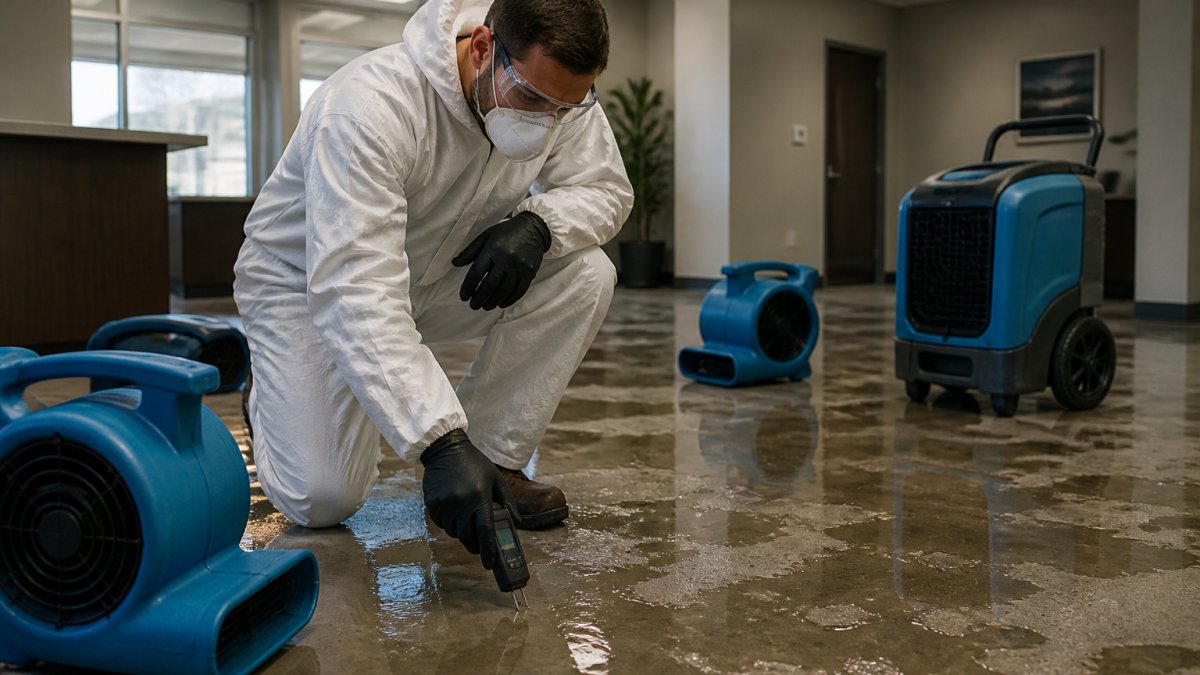
Emergency water extraction is the first physical step, and speed matters more than almost anything else. Standing water keeps spreading into drywall, carpet, and subfloor, so every hour of delay widens the damage.
Moisture mapping comes next. A hygrometer measures air humidity, while thermal imaging finds wet pockets behind walls that look dry. Without it, crews dry the visible space and leave hidden moisture to feed mold.
Structural drying then runs for days, not hours. Air movers keep air moving across wet surfaces, and industrial dehumidifiers pull that moisture out of the air. Equipment stays in place until readings confirm the structure is dry.
Pulling drying equipment early to reopen faster is the most expensive shortcut in commercial restoration. Moisture left in wall cavities triggers mold growth within days, and the second cleanup costs far more than the first.
Mold Prevention, Sanitization, and HVAC System Decontamination
Mold prevention starts during drying, not after it. Mold needs moisture, so a structure dried to verified levels rarely grows it. When water sat before extraction, antimicrobial treatment and remediation become part of the job.
HVAC system decontamination matters more than most owners realize. When water enters a rooftop unit or ductwork, the system spreads spores through the building every time it runs. Cleaning it protects the air everyone breathes.
Water Damage Restoration Timeline: How Long Before You Reopen
A typical commercial water damage restoration timeline runs three to five days for drying, with repairs adding one to three weeks depending on the damage.
The variables that stretch a timeline:
- How long the water sat before extraction
- Which water category is involved
- How much of the building is affected
- Whether materials can be dried or must be replaced
- How fast your insurer approves the scope of work
What Drives Commercial Water Damage Cleanup Cost
Commercial water damage cleanup cost depends on the size of the affected area, the water category, the materials involved, and how much demolition and rebuild the job requires. There is no flat rate, and any provider quoting one before seeing the property is guessing.
We direct every owner to request a written scope of work before signing anything. A fair estimate lists extraction, drying equipment, monitoring visits, sanitization, and repairs as separate line items.
Ask for the drying log before you approve the final invoice. It shows daily moisture readings, and it is the single best proof that the equipment stayed on site long enough to finish the job.
Insurance Documentation Best Practices for Commercial Claims
Strong insurance documentation is the difference between a paid claim and a fight.
Documentation has to start before a single wet vacuum is plugged in.
Document these items from day one:
- Photos and video of every affected area before work starts, shot wide and close, with a tape measure or coin in frame for scale
- Moisture readings with dates, times, and locations, tied to a floor plan sketch
- The water category and its source, with the plumbing or HVAC failure identified
- A written scope of work with line-item costs, not a lump sum
- Daily drying logs and equipment placement records
- Receipts for emergency mitigation, temporary repairs, and any equipment rental
- A chain-of-custody log if damaged materials are removed and stored
Keep a running log of business interruption losses too: lost sales, temporary relocation costs, spoiled inventory, staff overtime, and expediting fees.
Three mechanisms decide how much of your claim gets paid:
- Deductible and sublimits. A commercial policy may carry a separate deductible for water damage, and mold remediation often sits under a sublimit far below the main coverage limit. Read those numbers before the loss, not after.
- Depreciation and recoverable holdback. On a replacement cost policy, the insurer typically pays actual cash value first and releases the depreciation holdback once repairs are complete and invoiced. That means you need to keep every contractor invoice, not just the estimate.
- Proof of loss and the claim deadline. Most policies require a signed proof of loss within a set window after the loss, often 60 days, and a suit-limitation clause that can bar a claim if you wait too long. Missing that window is one of the few mistakes an adjuster cannot fix.
A common pattern is owners handing the insurer a single restoration invoice and assuming the work speaks for itself. It does not.
The FEMA guidance on documenting disaster damage recommends photographing damage before cleanup begins, which is exactly why documentation has to start on day one.
Do not sign a proof of loss or accept a final payment until the scope of work is fully documented and the depreciation holdback is accounted for. Once you sign, reopening the claim is difficult and often impossible.
Business Continuity Planning: Keeping Operations Alive During Cleanup
Business continuity planning during water damage means deciding in advance how the business keeps running while the building dries. Most mitigation plans focus on the building and forget the operations inside it.
Businesses that recover efficiently often have three things ready before anything floods:
- A list of essential functions and where each can run temporarily
- Contact information for staff, key customers, and your insurer
- A pre-approved restoration provider
If you have never written a continuity plan, start with one page: who calls whom, where work continues, and which systems come back first.
Commercial Water Damage Prevention and Regulatory Compliance
Commercial water damage prevention comes down to inspection and maintenance on a schedule, not on memory. Most failures were visible weeks earlier to anyone who looked.
A practical cadence for most commercial buildings:
- Monthly: walk the mechanical rooms, check supply lines under sinks and ice machines, look for rust or mineral staining on pipe joints, and confirm floor drains are clear.
- Quarterly: inspect rooftop HVAC units and condensate drain pans, test sump pumps and backflow preventers, and check the condition of the roof membrane around penetrations.
- Annually: have a licensed plumber inspect the main water service and any pipe over 20 years old, flush the water heater, and review the fire sprinkler system with a qualified contractor.
- Before storm season: clear roof drains and scuppers, verify the sump pump has backup power, and check that exterior grading slopes away from the foundation.
Three prevention investments pay for themselves faster than the rest:
- Water leak detection sensors placed at the main water meter, under raised floors, and near HVAC condensate lines. Modern systems shut off the main valve automatically when they detect continuous flow.
- Backflow preventers and floor drain maintenance. A sewage backup is the most expensive category of commercial water damage because it contaminates everything it touches. A functioning backflow preventer keeps municipal sewage out of your building.
- A documented shutoff map. Every facility manager should know where the main water shutoff, the sprinkler riser shutoff, and the HVAC condensate shutoffs are, and how to operate them. During a pipe burst, minutes matter.
Regulatory compliance adds a second layer, and it is where most owners get surprised. Commercial repairs must meet the applicable building code, which in many jurisdictions means permits and inspections for work that would be unpermitted in a house.
Mold remediation in commercial buildings should follow established restoration protocols. The IICRC restoration standards define how assessment, containment, and documentation should be handled, and following them gives you a defensible record if the work is ever questioned. Indoor air quality guidance from the EPA on mold and moisture control is a useful reference for owners managing a remediation project, particularly on moisture control as the primary mold prevention strategy.
Worker safety during cleanup is governed by OSHA standards for workplace safety.
Prevention and compliance are the same job seen from two angles. A building that is inspected on a schedule, documented, and repaired to code is a building that resists the next water event, and a building whose owner can prove the claim when one happens anyway.
Conclusion
The hardest part of commercial water damage is not the water. It is the downtime, the claim, and the decisions you make in the first 24 hours. Sentinel Restoration handles water damage, mold remediation, and storm recovery with IICRC-certified teams, advanced moisture detection, and a meticulous approach to every project. We restore properties to their pre-loss condition and help owners navigate the insurance process along the way. Contact us to get your building dry and your doors open again.
Frequently Asked Questions
What is water damage cleanup for commercial buildings called?
The industry term is commercial water damage restoration or mitigation. It covers emergency water extraction, structural drying, dehumidification, sanitization, antimicrobial treatment, and property restoration. Mitigation stops the damage from spreading; restoration returns the building to its pre-loss condition. IICRC-certified firms follow standardized restoration protocols for both phases.
How long does water damage restoration take in a commercial building?
Most commercial projects take three to seven days for extraction and structural drying, depending on the water category and how many materials are affected. Category 1 water from a clean supply line dries fastest. Category 2 gray water and Category 3 black water, such as sewage backups, add time for sanitization and disposal. Reconstruction after drying can extend the water damage restoration timeline by weeks.
Can a commercial building stay open during water damage cleanup?
Often yes, if the damage is contained to one zone. Contractors can set up containment barriers, run air scrubbers, and schedule noisy extraction or drying work after hours. Buildings with Category 3 black water contamination, HVAC system contamination, or compromised structural integrity usually need partial or full closure. A water damage assessment will confirm which areas are safe for staff and customers.
What should a business do first after water damage?
Shut off the water source if it is safe, cut power to affected areas, and call a restoration company for emergency response. Document everything with photos and video before anything is moved or discarded. Contact your insurer the same day. Do not walk through standing water near electrical panels, and do not use a household vacuum on flood water. Fast action limits mold growth, which can start within 24 to 48 hours.