Last Updated: November 10, 2026
Quick Summary
Identifying hidden mold after water damage starts with your nose and eyes, not a test kit: watch for a musty odor, dark stains or rings, and soft or warped materials. Two or more signs together usually mean moisture is still trapped somewhere. Mold can start growing within 24 to 48 hours of water damage.
- A musty odor is the most reliable early warning and often appears before any visible growth.
- Water travels along studs, joists, and subfloor seams, so mold can be several feet from the leak.
- Wear an N95 respirator, gloves, and eye protection, and keep children and pets out of the area.
- Stop and call a professional when suspected growth covers more than roughly 10 square feet.
- Re-read the same spots 24 to 48 hours later; readings that hold steady or climb mean moisture is still entering.
Table of Contents
- Signs of Hidden Mold After Water Damage
- How to Check for Mold After a Water Leak: A Room-by-Room Inspection
- How Long It Takes Mold to Grow After Water Damage
- Water Damage vs. Mold on Wood: Telling the Difference
- Using Moisture Meters to Detect Concealed Moisture
- When to Call a Professional for Mold Assessment
- Schedule Your Professional Mold Inspection
- Frequently Asked Questions
Signs of Hidden Mold After Water Damage
Identifying hidden mold after water damage starts with your nose and eyes, not a test kit.
Mold needs moisture, food (wood, drywall paper, dust), and time. Remove the moisture and you stop the problem; miss it and it spreads.
- A musty, earthy smell that gets stronger when the heat or AC runs
- Dark spots or rings on walls, ceilings, or baseboards
- Flooring that cups, buckles, or feels spongy underfoot
One sign alone is a hint. For the full recovery plan, see what to do after water damage in your home.
Musty Odors and Persistent Smells
A musty odor is the most reliable early warning you have. It comes from mold spores and the gases they release as they break down building materials.
The smell often appears before any visible growth, so don’t dismiss it as “just a damp basement.”
- Crawl spaces and basements, especially near the foundation
- Under sinks and behind appliances
- Closets on exterior walls
If the smell fades when you leave the room and returns when you come back, the source is in that room.
Water Stains, Discoloration, and Warped Materials
Stains show where water traveled: a brown ceiling ring usually means a leak above, and a dark baseboard line points to water wicking up from the floor.
- Yellow, brown, or rust-colored rings on ceilings and walls
- Dark staining along the bottom of drywall
- Baseboards that pull away from the wall or feel soft
Warped flooring is more than cosmetic. Cupping and buckling mean the wood absorbed water and is drying unevenly, and mold can grow on the underside before you see it from above.
How to Check for Mold After a Water Leak: A Room-by-Room Inspection
Checking for mold after a leak means working from the outside in: smell, then sight, then moisture readings. You are looking for clues, not confirming a diagnosis.
Work one room at a time, start at the water source, and move outward and downward along the path water would have traveled.
Safety Precautions Before You Start
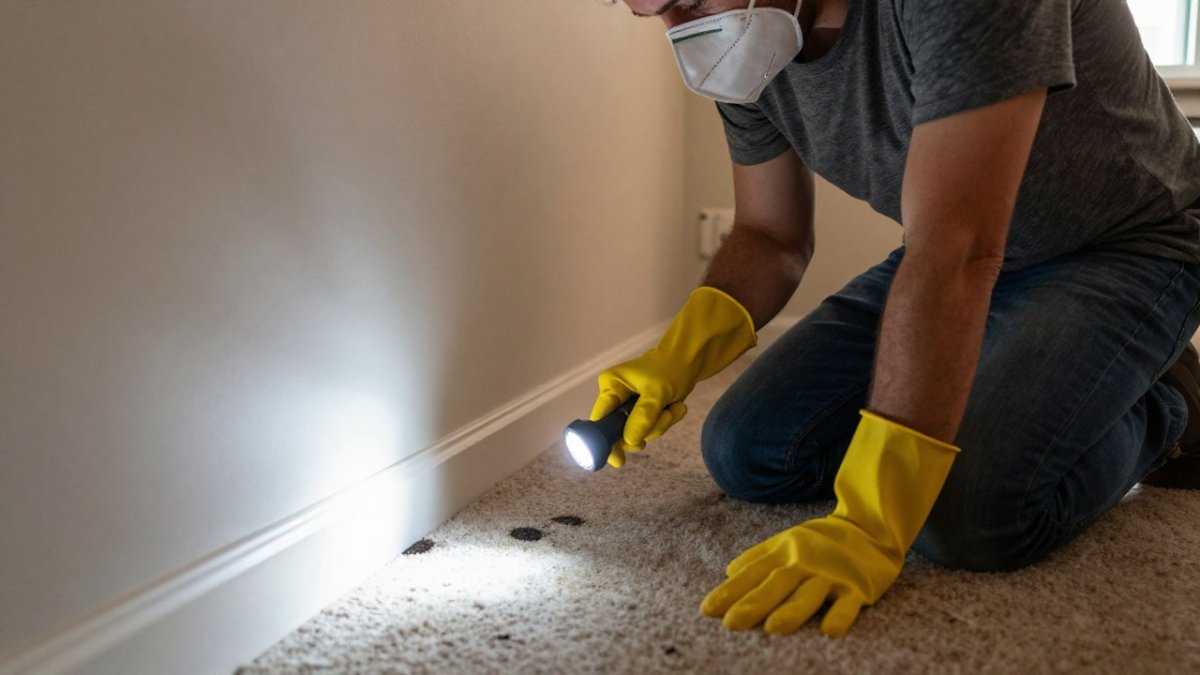
Protect yourself first. Disturbing mold sends spores into the air, and you do not want to breathe them.
- Wear an N95 respirator, not a cloth mask
- Put on gloves and eye protection
- Keep children and pets out of the area
If you see more than a small patch, or the area smells strongly, stop and call a professional, disturbing a large colony without containment spreads spores through the house. People with asthma, allergies, or other respiratory sensitivities should not inspect at all.
Step-by-Step Inspection Workflow
Work one room at a time and write down what you find. A simple log keeps you from missing spots.
- Start at the source. Trace the water’s path downhill, it follows studs, joists, and subfloor seams, so the visible wet spot is rarely the full extent.
- Check the baseboards. Look for dark lines, soft wood, and gaps from the wall. Probe gently with a screwdriver handle; soft drywall paper or crumbly wood indicates prolonged wetting.
- Look up. Examine ceilings for rings and sagging, especially under bathrooms and near exterior walls.
- Open cabinets. Check under sinks, behind the fridge, and inside closets on exterior walls, especially the back panel and cabinet floor where water pools.
- Pull back carpet edges. Check the tack strip and padding for dark stains, padding stays wet far longer than the carpet face and is a common hidden reservoir.
- Check behind outlets. With power off, remove a cover plate and look inside the wall cavity. Visual inspection only, no tools in the cavity.
- Smell each room. Note any musty odor and where it is strongest; odor that intensifies when the HVAC runs points to growth in the ductwork or a return plenum.
- Take moisture readings. Use a moisture meter on suspect materials and record the reading and material type for later comparison.
A common mistake is checking only the obvious wet spot, water travels along studs, joists, and subfloor, so mold can be several feet from the leak. Another is inspecting from the doorway; musty odors concentrate in corners, closets, and low spots, so step fully into each room.
Material-Specific Inspection Notes
Different materials hide moisture differently, and the inspection step changes with the material:
- Drywall: Paper facing wicks water upward and sideways. Look for softness, bubbling paint, and dark staining at the bottom edge. Drywall that has been wet for more than a day or two is usually not salvageable in the affected area.
- Insulation: Fiberglass batts trap water against framing and dry slowly. If insulation is wet or compressed, assume the cavity behind it needs professional drying.
- Carpet and padding: Padding is the reservoir. Pull back a corner and check the tack strip and subfloor; carpet that smells musty after cleaning usually has contaminated padding underneath.
When to Stop and Call a Professional
Stop the inspection and bring in a professional when any of the following is true:
- The suspected growth covers more than roughly 10 square feet
- You cannot find or stop the moisture source
- The musty odor returns after cleaning
A professional assessment can help answer what a visual inspection cannot: whether concealed moisture is still active, and whether growth has established itself inside the assembly.
How Long It Takes Mold to Grow After Water Damage
Mold can start growing within 24 to 48 hours of water damage in the right conditions.
- Warm temperatures
- High humidity
- Porous materials like drywall, carpet, and insulation
A room is not “dry” because the carpet feels dry, it is dry when moisture readings in the framing and subfloor return to normal. To slow the spread before help arrives, read our guide on how to stop water damage from spreading fast.
Water Damage vs. Mold on Wood: Telling the Difference
Water damage and mold on wood look similar at first glance. Both darken the surface and both soften the material. The difference is in the pattern and the smell.
| Clue | Water Damage Alone | Water Damage Plus Mold |
|---|---|---|
| Color | Uniform staining, tide lines | Dark spots, fuzzy or powdery patches |
| Texture | Swollen, soft, warped | Fuzzy, speckled, or powdery surface |
| Smell | Damp, earthy | Sharp musty odor |
| Pattern | Follows water path | Spreads in circles or clusters |
| Growth | None | Visible fuzz, black or green specks |
Water stains form clean rings where water dried; mold grows in irregular, fuzzy patches. If you are unsure, a moisture meter and a professional assessment settle it.
Using Moisture Meters to Detect Concealed Moisture
A moisture meter separates a guess from an answer, finding concealed moisture behind walls and under floors. But the reading itself is not the answer, the comparison is. A single number tells you little unless you know what the same material reads in a known-dry area of the same home.
- Pin meters push two probes into the material for a direct reading. They are the most reliable option for wood framing, subfloor, and drywall, but they leave small holes.
- Pinless meters scan the surface without damage. They are useful for broad scans across drywall, tile, and finished surfaces, but readings are affected by what is behind the surface and by the material’s density.
Where to Take Readings
Take readings in a pattern, not at random. For each suspect room:
- Establish a baseline. Find a known-dry area of the same material, an interior wall in a room unaffected by the water event is a good choice, and take three readings there. Average them.
- Scan the suspect area. Take readings at the base of each wall, around the water source, along the ceiling below any upper-floor bathroom, and under windows. Record each reading and the material.
- Compare like to like. A drywall reading only means something against another drywall reading. Do not compare a wood stud reading to a drywall reading; the materials hold water differently.
How to Interpret What You Find
- Elevation above baseline. A suspect area that reads consistently higher than the known-dry baseline of the same material is a moisture clue worth acting on.
- Consistency across the area. A single high reading can be a false positive from a metal stud, a pipe, or surface condensation. Several high readings in a pattern are more meaningful.
- Change over time. Re-read the same spots 24 to 48 hours later. Readings that drop mean drying is working. Readings that hold steady or climb mean moisture is still entering the assembly.
A meter tells you where water is, not whether mold is there. Mold can grow on a surface that reads dry because growth is on the back of the drywall or underside of the subfloor, and wet materials do not always show visible growth yet.
Watch out: pinless meters can read through drywall and give a falsely high number when a metal stud, wire, or pipe sits just behind the surface. Confirm any suspicious pinless reading with a pin meter in an adjacent porous material.
What to Do With the Readings
If readings are elevated and not dropping, find and stop the moisture source, then dry the assembly, a box fan does not dry inside a wall cavity. If readings stay high after 48 hours of drying or you cannot locate the source, bring in a professional with thermal imaging and cavity drying equipment. Keep your reading log for the contractor and your insurance claim.
When to Call a Professional for Mold Assessment
Signs it is time to call:
- Mold larger than roughly 10 square feet
- Growth inside walls, HVAC, or under flooring
- A musty smell that returns after cleaning
Mold spores can trigger allergy symptoms and respiratory irritation, and people with asthma or other respiratory sensitivities should be especially careful (the CDC). If people in the home are coughing or sneezing more since the leak, that is your signal.
Before you hire anyone, understand what the job involves. Our water damage restoration cost guide breaks down what drives the price, and our guide on whether insurance pays for water restoration explains how claims usually work.
Schedule Your Professional Mold Inspection
The hardest part of hidden mold is that it hides.
Sentinel Restoration is IICRC-certified and uses advanced moisture detection to find concealed moisture before it becomes a bigger problem.
Do not wait for the smell to get worse. Our emergency water damage restoration guide shows what happens when you call, and our team is ready to inspect, assess, and remediate.
Hidden mold does not fix itself, and it will not wait. If you have spotted the signs in this guide, the safest next step is a professional inspection.
Frequently Asked Questions
How can you tell if there is hidden mold after water damage?
Hidden mold often reveals itself through a musty odor, unexplained allergy symptoms like coughing or sneezing, and subtle water stains on walls or ceilings. You may also notice warped flooring or bubbling paint. A moisture meter can confirm damp materials behind walls. If these signs persist, a professional assessment with moisture readings and surface sampling can identify concealed growth before it spreads.
How long does it take for mold to grow after water damage?
Mold can begin growing within 24 to 48 hours after water damage if moisture remains. Porous materials like drywall and carpet are especially vulnerable. Drying must start immediately to prevent growth. If water sat for more than two days, assume mold has started and inspect thoroughly. Visible mold often appears within a week, but hidden mold behind walls may take longer to show obvious signs.
Can you have mold behind walls without seeing it?
Yes, mold frequently grows behind walls, under flooring, and inside ceilings without visible evidence. Signs include a persistent musty smell, discoloration around baseboards, and allergy symptoms that worsen indoors. Moisture meters and thermal imaging can detect concealed moisture that feeds mold. If you suspect hidden mold, avoid cutting into walls yourself and call a certified professional to assess and remediate safely.
What are the first signs of mold sickness?
Early signs of mold exposure often mimic allergies: sneezing, coughing, runny nose, and eye irritation. Some people experience respiratory irritation or skin rashes. Symptoms that improve when you leave the building suggest an indoor mold issue. If you notice these symptoms along with a musty odor or recent water damage, arrange a professional inspection to identify and address hidden mold before it affects your health further.