Table of Contents
- Assess the Leak and Stop the Water Source
- Wet Carpet Water Extraction: Remove Standing Water First
- Use a Wet/Dry Vacuum to Extract Water from Carpet
- How Long Carpet Takes to Dry After a Leak
- Blot, Lift, and Dry Carpet Padding and Subfloor
- How to Remove Water Smell from Carpet
- When to Replace Carpet After Water Damage
- Frequently Asked Questions
Last Updated: October 18, 2026
Assess the Leak and Stop the Water Source
Before you touch a towel, find the leak and shut it off. Every minute water keeps flowing, it spreads further into carpet fibers, padding, and subfloor.
Here’s your quick triage list:
- Shut off the main water valve or the supply line feeding the leak
- Kill power to any room with water near outlets or appliances
- Photograph everything before you move a single item
- Note the time you found the water
If the leak comes from a roof or storm flooding, you can’t shut it off. In that case, focus on safety and call for help.
Check for Contamination and Electrical Hazards
Not all water is equal. Clean water from a supply line is low risk. Water from a toilet, washing machine drain, or outdoor flooding can carry bacteria and sewage. Treat any dark, smelly water as contaminated and wear gloves and boots.
Electrical danger is the bigger threat. Water plus live current can kill. Shut off breakers to wet rooms before you enter. If the breaker box itself is wet, stay out and call an electrician.
Wet Carpet Water Extraction: Remove Standing Water First
Standing water is your first target. The faster you pull it out, the less soaks into padding and subfloor. Use a water pump for deep pools and a wet/dry vacuum for the rest.
Work from the farthest corner toward the exit so you don’t walk back through wet carpet. Push water toward your extraction point in slow, even passes.
What most guides miss: the carpet backing holds water long after the surface looks dry. Press a dry paper towel into the carpet. If it comes up damp, keep extracting.
Use a Wet/Dry Vacuum to Extract Water from Carpet
A wet/dry vacuum is the workhorse of wet carpet water extraction. It pulls water out of carpet fibers far better than towels alone.
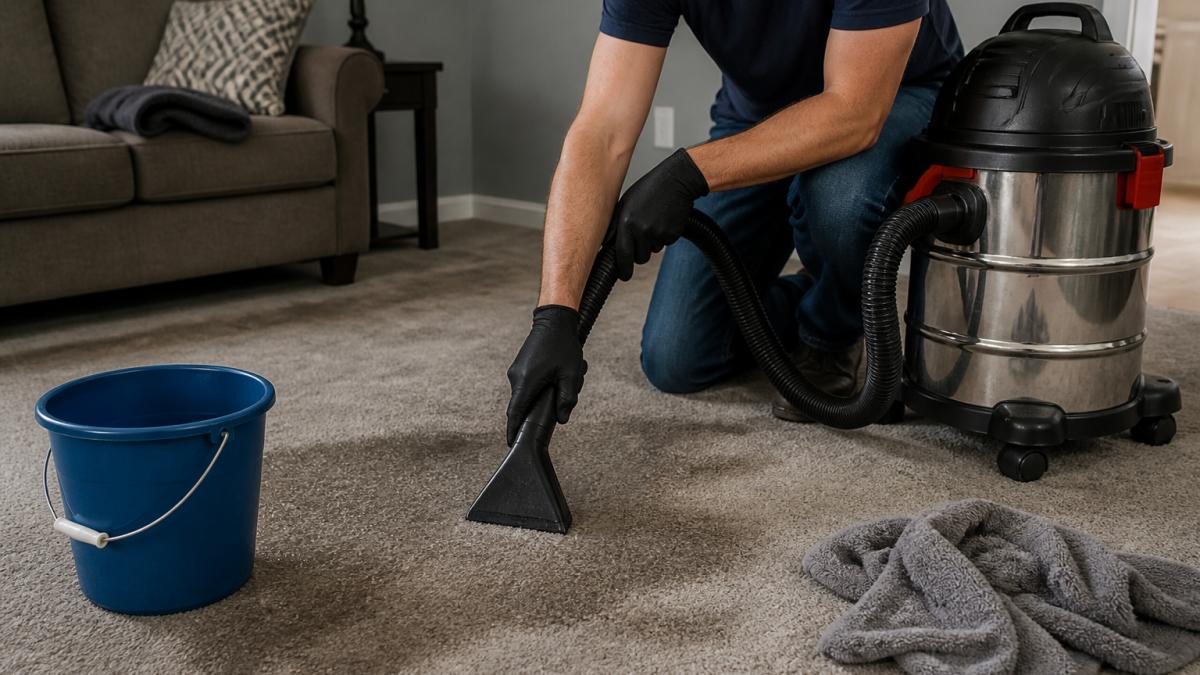
Here’s how to extract water from carpet with one:
- Empty the tank and check the filter is removed for wet mode
- Use the wide floor nozzle, not the small crevice tool
- Overlap each pass by half the nozzle width
- Go slow. Rushing leaves water behind
- Empty the tank before it fills to the max line
Make two or three passes over the same spot. You should hear the pitch change as the carpet dries.
Pull the nozzle toward you at a slight angle. This lifts carpet fibers and lets air reach the backing, which speeds drying.
How Long Carpet Takes to Dry After a Leak
Most carpet takes 24 to 72 hours to dry after a leak, but that range is only useful if you know what “dry” actually means. Surface feel is a poor test. Carpet fibers can feel dry to the touch while the backing, padding, and subfloor underneath still hold enough moisture to feed mold.
Realistic drying timelines
Use these as planning benchmarks, not guarantees:
- Thin carpet over a concrete subfloor with good airflow: often dry in 24 to 36 hours
- Standard carpet with a thin pad and a dehumidifier running: roughly 36 to 48 hours
- Thick carpet with a soaked pad left in place: 48 to 72 hours, and sometimes longer
- Carpet in a confined space with poor ventilation: add 24 hours or more
Cool room temperatures and high indoor humidity stretch every timeline. A common pattern is for homeowners to shut the room off and close the door, which traps moisture and slows drying dramatically.
How to verify dryness at each layer
The surface is the last place to dry, not the first. Check in this order:
- Subfloor. Press a dry paper towel against the subfloor where you lifted the carpet. Any darkening means moisture is still present. On wood subfloor, look for soft spots or swelling.
- Padding. Squeeze a corner of the padding between your fingers. It should feel springy and dry, not cool or damp. A moisture meter gives a clearer reading than touch.
- Carpet backing. Fold back a corner and press a dry paper towel against the backing. Dampness on the towel means keep drying.
- Carpet surface. Only after the layers below read dry should you trust the surface feel.
A pin-type or pinless moisture meter is the most reliable tool. Most restoration practitioners take readings at several points across the room rather than one spot, because water spreads unevenly under carpet.
The 48-hour mold window
Mold can begin colonizing wet organic material within 24 to 48 hours under the right conditions. Many restoration pros treat 48 hours as the point where mold risk becomes a real concern, and 72 hours as the point where materials that are still wet should be evaluated for removal. If the padding or subfloor still reads damp at the 48-hour mark, increase airflow and dehumidification rather than waiting.
Do not rely on a fan alone to dry a soaked pad. Air movement dries the surface but can leave moisture trapped underneath. Pair fans with a dehumidifier, and check the pad directly.
When drying is not progressing
If readings have not improved after 24 hours of active drying, something is blocking airflow, usually soaked padding, a sealed room, or carpet that was never lifted. Stop adding equipment and fix the airflow problem first. If the carpet cannot be lifted or the room cannot be ventilated, that is the point to bring in professional drying equipment.
Blot, Lift, and Dry Carpet Padding and Subfloor
Towels handle the surface. Padding and subfloor need a decision, not just more blotting. The question is whether the padding can be dried in place or has to come out, and that depends on how saturated it is, what kind of water hit it, and how much time has passed.
Blot first, then assess
Press clean, dry towels into the carpet to pull surface moisture. Replace towels as they soak through. Once the surface stops transferring water to the towel, lift a corner of the carpet to inspect the padding underneath.
Decision rules: dry in place vs. remove
Use these criteria to decide:
- Dry in place when the padding is damp but not saturated, the water was clean (supply line, clean rain through a intact roof), and less than 24 hours have passed. Lift the carpet, run fans and a dehumidifier directly on the padding, and check readings daily.
- Remove the padding when it is soaked through, when it has been wet more than 24 to 48 hours, when the water was contaminated, or when it stays damp after a day of direct airflow. Saturated padding rarely dries fully in place, and trapped moisture is the most common cause of lingering musty odor.
- Remove carpet and padding when the water was contaminated (sewage, outdoor flooding, toilet overflow), when mold is visible, or when the carpet has delaminated or shrunk.
How to lift carpet safely
- Pull the carpet loose from the tack strip along one wall, working a small section at a time
- Fold it back carefully, carpet and padding together if the padding is coming out
- Keep the folded carpet off the wet subfloor so it does not re-wick moisture
- Dry the subfloor with fans and a dehumidifier before deciding whether to reuse the carpet
Subfloor differences matter
Concrete subfloors dry slowly and can hold moisture for days; they need direct airflow and a dehumidifier, and readings should be taken at the surface. Wood subfloors dry faster but are more vulnerable to swelling, cupping, and delamination, check for soft spots and replace any board that stays damp. In both cases, the subfloor must read dry before carpet or new padding goes back down.
Replacing padding vs. reusing it
Soaked padding is usually cheaper to replace than to fight mold later. When in doubt, replace it. Padding is a relatively low-cost material compared with the cost of mold remediation or subfloor repair, and a fresh pad also restores the carpet’s feel and cushioning.
If you remove padding, cut it into manageable sections and bag it for disposal. Keep a small offcut as a reference for matching thickness and density when you buy replacement padding.
When to stop and call a professional
If the subfloor stays damp after 48 hours of active drying, if the wet area covers more than a small room, or if the water was contaminated, professional drying equipment and containment are the safer path. Restoration crews use commercial dehumidifiers, air movers, and moisture meters that homeowner equipment cannot match.
How to Remove Water Smell from Carpet
Musty odor means moisture is still trapped. The smell won’t leave until the carpet is truly dry.
Try these steps:
- Run fans and a dehumidifier until the carpet is bone dry
- Sprinkle baking soda on dry carpet, let it sit, then vacuum
- Wash hard surfaces with a mild cleaner
- Ventilate the room with open windows and cross airflow
If the smell lingers after drying, mold may be growing in the padding or subfloor. That’s when professional restoration is worth the call.
Never seal or shampoo a damp carpet to hide odor. Trapping moisture under cleaner locks in the musty smell and feeds mold growth.
When to Replace Carpet After Water Damage
Replace carpet when it can’t dry within 48 to 72 hours, when the water was contaminated, or when mold has started. Delaying replacement risks your health and your subfloor.
Replace it if:
- Water came from sewage or outdoor flooding
- Padding is soaked and can’t be dried
- Mold or mildew is visible
- The carpet has delaminated or shrunk
For clean-water leaks caught early, drying usually saves the carpet. For dirty water, replacement is the safer call.
| Situation | Action | Why |
|---|---|---|
| Clean water, caught fast | Extract and dry in place | Saves carpet and cost |
| Clean water, soaked padding | Pull padding, dry subfloor | Padding rarely dries fully |
| Contaminated water | Replace carpet and padding | Health risk from bacteria |
| Mold present | Replace affected materials | Mold spreads if trapped |
Frequently Asked Questions
How long does a carpet take to dry after a water leak?
Most carpets dry within 24 to 72 hours if you extract standing water promptly and run fans and a dehumidifier. Thick padding and humid conditions can push drying past three days. Check the carpet backing and padding daily; if they stay damp beyond 48 hours, mold risk rises sharply. Professional moisture meters give a definitive reading, and restoration teams often dry carpets in 1 to 2 days with commercial air movers.
Can you save carpet that has been soaked by a leak?
Yes, if the water is clean and you act within 24 to 48 hours. Extract water with a wet/dry vacuum, blot remaining moisture, lift the carpet to dry the padding, and run fans and a dehumidifier. Carpet soaked by contaminated water, such as sewage or floodwater, usually must be removed. If the carpet has delaminated backing, a musty odor, or visible mold, replacement is the safer choice.
What will draw water out of carpet?
A wet/dry vacuum is the fastest tool for pulling water out of carpet fibers. For smaller spots, press clean towels into the carpet and stand on them to absorb moisture. A water pump or extraction machine handles standing water before vacuuming. After extraction, airflow from fans and a dehumidifier pulls remaining moisture out of the carpet and padding. Avoid scrubbing, which pushes water deeper into the backing.
When should you call a professional for wet carpet?
Call a professional if water covers more than a small area, if the leak involves contaminated water, or if the carpet is still damp after 48 hours. IICRC-certified technicians use moisture meters and thermal imaging to find hidden water in padding and subfloor, then dry the space with commercial equipment. Professional restoration also helps document damage for insurance claims and lowers the chance of mold returning.
A leak doesn’t have to mean a full carpet replacement, but it does demand fast action. If the water is deep, the padding is soaked, or you smell mildew, call in the pros. At Sentinel Restoration, our IICRC-certified team uses advanced moisture detection to find hidden dampness and dry your carpet to pre-loss condition. We handle water damage and mold remediation under one roof, so you’re not juggling contractors. Contact us to schedule an assessment and get your home dry again.